 |
Datenblatt-Suchmaschine für elektronische Bauteile |
|
|
Datenblatt-Suchmaschine für elektronische Bauteile |
|
The question interval is too short.
Please try again in a few seconds.

Hello, Please ask a question about YB1303 Datasheet
# Example questions:
➢ Describe how led brightness is controlled in 'scenario 3 – pwm - 2'.
➢ What is the key consideration regarding the input voltage (v in) when driving high vf (forward voltage) white or blue leds with the yb1303?
➢ What is the primary benefit of using the yb1303 with a single-cell li-ion battery for lcd or keyboard backlighting?
| Part No. | YB1303 |
| Manufacturer | YOBON |
| Size | 443 Kbytes |
| Pages | 8 pages |
| Description | Low Dropout LED Driver |


1. Overview & Purpose:
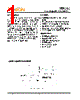
️· The YB1303 is an ultra-low dropout (ULDO) LED driver. This means it can efficiently drive LEDs even with a small difference between the input voltage and the voltage needed by the LEDs.
️· It's designed for flexible brightness control via both analog (voltage) and PWM (pulse-width modulation) methods.
2. Key Features & Benefits:
️· Ultra-Low Dropout: Allows efficient LED driving with minimal voltage difference.
️· Analog and PWM Control: Offers versatile brightness adjustment.
️· Wide Input Voltage Range: Suitable for various power sources (Li-Ion batteries, existing voltage buses).
️· Current Matching: Eliminates the need for external current-matching resistors and transistors.
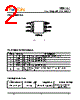
️· Compact Size (SC70-6 Package): Good for space-constrained applications.
3. Operation & Control:
️· LED Current Control Equations:
- Analog: `I_LED = 200 * (V_CONTROL - V_CTR) / R_SET`
- PWM (Scenario 1): `I_LED = 200 * (V_CONTROL - V_CTR) / R_SET` (V_CONTROL is PWM signal)
- PWM (Scenario 2): `I_LED ≈ 200 * I_SET` (Amplitude of V_EN doesn't affect current)
️· PWM Modes Explained:
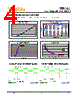
- Scenario 1: The amplitude of the PWM signal (V_CONTROL) determines the maximum LED current. Pulse width controls brightness.
- Scenario 2: The pulse width of V_EN signal controls brightness, amplitude does not affect current.
️· Recommended PWM Frequency: >100 Hz to prevent flickering; >1 MHz if necessary.
4. Application Examples & Scenarios:
️· Scenario 1: Driving Low-Forward-Voltage (Vf) LEDs from a Li-Ion Battery: This is ideal for LCD backlights and keyboards, eliminating the need for a boost converter.
️· Scenario 2: Driving High-Vf LEDs from an Existing Voltage Bus: This uses the existing power supply, avoiding the need for a boost circuit.
️· Scenario 1: Driving a String of LEDs: Provides flexible brightness control for multiple LEDs.
5. Important Considerations:
️· Maximum Input Voltage: Avoid exceeding the absolute maximum input voltage specified in the datasheet.
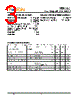
️· Thermal Management: Carefully consider heat dissipation. The maximum power dissipation depends on the ambient temperature and the LED voltage.
️· Enable (EN) Signal: Make sure the EN signal is high before applying the input voltage.
️· Datasheet: Always refer to the full datasheet for detailed specifications, timing diagrams, and application circuits.
In essence, the YB1303 is a versatile and efficient LED driver suited for a wide range of applications where low voltage drop and flexible brightness control are required.
1. Overview & Purpose:
️· The YB1303 is an ultra-low dropout (ULDO) LED driver. This means it can efficiently drive LEDs even with a small difference between the input voltage and the voltage needed by the LEDs.
️· It's designed for flexible brightness control via both analog (voltage) and PWM (pulse-width modulation) methods.
2. Key Features & Benefits:
️· Ultra-Low Dropout: Allows efficient LED driving with minimal voltage difference.
️· Analog and PWM Control: Offers versatile brightness adjustment.
️· Wide Input Voltage Range: Suitable for various power sources (Li-Ion batteries, existing voltage buses).
️· Current Matching: Eliminates the need for external current-matching resistors and transistors.
️· Compact Size (SC70-6 Package): Good for space-constrained applications.
3. Operation & Control:
️· LED Current Control Equations:
- Analog: `I_LED = 200 * (V_CONTROL - V_CTR) / R_SET`
- PWM (Scenario 1): `I_LED = 200 * (V_CONTROL - V_CTR) / R_SET` (V_CONTROL is PWM signal)
- PWM (Scenario 2): `I_LED ≈ 200 * I_SET` (Amplitude of V_EN doesn't affect current)
️· PWM Modes Explained:
- Scenario 1: The amplitude of the PWM signal (V_CONTROL) determines the maximum LED current. Pulse width controls brightness.
- Scenario 2: The pulse width of V_EN signal controls brightness, amplitude does not affect current.
️· Recommended PWM Frequency: >100 Hz to prevent flickering; >1 MHz if necessary.
4. Application Examples & Scenarios:
️· Scenario 1: Driving Low-Forward-Voltage (Vf) LEDs from a Li-Ion Battery: This is ideal for LCD backlights and keyboards, eliminating the need for a boost converter.
️· Scenario 2: Driving High-Vf LEDs from an Existing Voltage Bus: This uses the existing power supply, avoiding the need for a boost circuit.
️· Scenario 1: Driving a String of LEDs: Provides flexible brightness control for multiple LEDs.
5. Important Considerations:
️· Maximum Input Voltage: Avoid exceeding the absolute maximum input voltage specified in the datasheet.
️· Thermal Management: Carefully consider heat dissipation. The maximum power dissipation depends on the ambient temperature and the LED voltage.
️· Enable (EN) Signal: Make sure the EN signal is high before applying the input voltage.
️· Datasheet: Always refer to the full datasheet for detailed specifications, timing diagrams, and application circuits.
In essence, the YB1303 is a versatile and efficient LED driver suited for a wide range of applications where low voltage drop and flexible brightness control are required.
| Part No. | YB1303 |
| Manufacturer | YOBON |
| Size | 443 Kbytes |
| Pages | 8 pages |
| Description | Low Dropout LED Driver |
| War ALLDATASHEET hilfreich? [ DONATE ] |
Über Alldatasheet | Werbung | Kontakt | Privatsphäre und Datenschutz | Link zum Datenblatt | Linktausch | Hersteller All Rights Reserved©Alldatasheet.com |
| Russian : Alldatasheetru.com | Korean : Alldatasheet.co.kr | Spanish : Alldatasheet.es | French : Alldatasheet.fr | Italian : Alldatasheetit.com Portuguese : Alldatasheetpt.com | Polish : Alldatasheet.pl | Vietnamese : Alldatasheet.vn Indian : Alldatasheet.in | Mexican : Alldatasheet.com.mx | British : Alldatasheet.co.uk | New Zealand : Alldatasheet.co.nz |
|
Family Site : ic2ic.com |
icmetro.com |
 German ▼
  English
 Chinese
 Japanese
 Russian
 Korean
 Spanish
 French
 Italian
 Portuguese
 Polish
 Vietnamese
 Indian
 Mexican
 British
 New Zealand