 |
Datenblatt-Suchmaschine für elektronische Bauteile |
|
|
Datenblatt-Suchmaschine für elektronische Bauteile |
|
The question interval is too short.
Please try again in a few seconds.

Hello, Please ask a question about RL1005-2-R100G Datasheet
# Example questions:
➢ G., jis c 5201-1). what general category of testing do these standards appear to cover?
➢ What are the dimensions (in mm) of the 'bending test' specimen (specifically, the thickness, bending width, and distance between fulcrums)?
➢ What is the maximum allowable change in resistance (∆r) for a component subjected to the 'load life' test, expressed as both a percentage and an absolute value in ohms?
| Part No. | RL1005-2-R100G |
| Manufacturer | DAESAN |
| Size | 236 Kbytes |
| Pages | 8 pages |
| Description | 1/8W, 0402 Low Resistance Chip Resistor (Lead / Halogen free) |






Overall Purpose:
These documents contain technical specifications for a surface mount resistor. They detail the required electrical, mechanical, and environmental performance characteristics. They also reference Japanese Industrial Standards (JIS) for testing and validation. The intention is to ensure the resistor meets a high standard of quality and reliability.
1. General Information / Document Structure:
️· Document Type: These are specifications for a resistor, likely to be used in electronic circuits.
️· Document Format: The document is broken up into multiple pages, each containing tables and descriptions of tests and specifications.
️· Referenced Standards: Heavily relies on JIS standards for testing methods. (JIS is a set of voluntary consensus standards maintained by the Japanese Industrial Standards Committee.)
2. Electrical Specifications & Tests
️· Short Time Overload: The resistor must withstand a short, high-power surge (2.5 times the rated power for 5 seconds) without significant damage.
- Metric: Change in Resistance (∆R) limited to a specified value, plus a percentage related to the nominal resistance. No burning or arcing allowed.
️· Insulation Resistance: Tests the resistance between the resistor's terminals and its protective film, and between the terminals and the substrate. High values are required.
️· Voltage Proof (Dielectric Withstand): Tests the resistor's ability to withstand a high AC voltage without breakdown.
- Metric: Limited change in resistance (∆R), no breakdown (arcing, fire).
️· Thermal Shock: Tests performance after repeated cycles between very low and very high temperatures.
- Metric: Limited change in resistance (∆R).
️· Low Temperature Storage: Tests performance after storage at a low temperature.
- Metric: Limited change in resistance (∆R).
️· High Temperature Exposure: Tests performance after exposure to a high temperature.
- Metric: Limited change in resistance (∆R).
️· Load Life: Tests performance under continuous rated voltage and power conditions over an extended period (1000 hours).
- Metric: Limited change in resistance (∆R).
️· Damp Heat with Load: Tests performance under high humidity and temperature while carrying a load.
- Metric: Limited change in resistance (∆R).
️· Mechanical Shock: Tests the resistance’s ability to endure a mechanical shock.
- Metric: Change in resistance (∆R).
️· Bending Test: Tests the resistor’s capability to withstand bending forces.
- Metric: Change in resistance (∆R).
3. Mechanical/Soldering Specifications
️· Solderability: The resistor’s surface must be easily solderable with good coverage (95% or greater).
️· Resistance to Soldering Heat: Resistor must withstand immersion in molten solder.
- Metric: Limited deformation in appearance, and change in resistance (∆R).
4. Dimensional Information
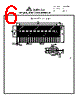
️· Diagrams: Page 7 contains a diagram with various dimensions labeled with "Col" numbers. This provides physical dimensions of the resistor's footprint and components.
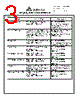
️· Table on Page 6: This table, labeled "Col1" through "Col36," provides a list of numerical values. The meaning of these values isn't explicitly defined but likely represents critical dimensions and spacing.
5. Packaging Information
️· Reel Dimensions: Page 8 includes dimensions and specifications for the reel used to package the resistors, including the number of holes.
Key Takeaways:
️· The resistor is intended for high-reliability electronic applications.
️· Testing is rigorous and covers a wide range of environmental and electrical stressors.
️· Compliance with JIS standards is a critical requirement.
️· Detailed dimensional information is provided for manufacturing and assembly.
Overall Purpose:
These documents contain technical specifications for a surface mount resistor. They detail the required electrical, mechanical, and environmental performance characteristics. They also reference Japanese Industrial Standards (JIS) for testing and validation. The intention is to ensure the resistor meets a high standard of quality and reliability.
1. General Information / Document Structure:
️· Document Type: These are specifications for a resistor, likely to be used in electronic circuits.
️· Document Format: The document is broken up into multiple pages, each containing tables and descriptions of tests and specifications.
️· Referenced Standards: Heavily relies on JIS standards for testing methods. (JIS is a set of voluntary consensus standards maintained by the Japanese Industrial Standards Committee.)
2. Electrical Specifications & Tests
️· Short Time Overload: The resistor must withstand a short, high-power surge (2.5 times the rated power for 5 seconds) without significant damage.
- Metric: Change in Resistance (∆R) limited to a specified value, plus a percentage related to the nominal resistance. No burning or arcing allowed.
️· Insulation Resistance: Tests the resistance between the resistor's terminals and its protective film, and between the terminals and the substrate. High values are required.
️· Voltage Proof (Dielectric Withstand): Tests the resistor's ability to withstand a high AC voltage without breakdown.
- Metric: Limited change in resistance (∆R), no breakdown (arcing, fire).
️· Thermal Shock: Tests performance after repeated cycles between very low and very high temperatures.
- Metric: Limited change in resistance (∆R).
️· Low Temperature Storage: Tests performance after storage at a low temperature.
- Metric: Limited change in resistance (∆R).
️· High Temperature Exposure: Tests performance after exposure to a high temperature.
- Metric: Limited change in resistance (∆R).
️· Load Life: Tests performance under continuous rated voltage and power conditions over an extended period (1000 hours).
- Metric: Limited change in resistance (∆R).
️· Damp Heat with Load: Tests performance under high humidity and temperature while carrying a load.
- Metric: Limited change in resistance (∆R).
️· Mechanical Shock: Tests the resistance’s ability to endure a mechanical shock.
- Metric: Change in resistance (∆R).
️· Bending Test: Tests the resistor’s capability to withstand bending forces.
- Metric: Change in resistance (∆R).
3. Mechanical/Soldering Specifications
️· Solderability: The resistor’s surface must be easily solderable with good coverage (95% or greater).
️· Resistance to Soldering Heat: Resistor must withstand immersion in molten solder.
- Metric: Limited deformation in appearance, and change in resistance (∆R).
4. Dimensional Information
️· Diagrams: Page 7 contains a diagram with various dimensions labeled with "Col" numbers. This provides physical dimensions of the resistor's footprint and components.
️· Table on Page 6: This table, labeled "Col1" through "Col36," provides a list of numerical values. The meaning of these values isn't explicitly defined but likely represents critical dimensions and spacing.
5. Packaging Information
️· Reel Dimensions: Page 8 includes dimensions and specifications for the reel used to package the resistors, including the number of holes.
Key Takeaways:
️· The resistor is intended for high-reliability electronic applications.
️· Testing is rigorous and covers a wide range of environmental and electrical stressors.
️· Compliance with JIS standards is a critical requirement.
️· Detailed dimensional information is provided for manufacturing and assembly.
| Part No. | RL1005-2-R100G |
| Manufacturer | DAESAN |
| Size | 236 Kbytes |
| Pages | 8 pages |
| Description | 1/8W, 0402 Low Resistance Chip Resistor (Lead / Halogen free) |
| War ALLDATASHEET hilfreich? [ DONATE ] |
Über Alldatasheet | Werbung | Kontakt | Privatsphäre und Datenschutz | Link zum Datenblatt | Linktausch | Hersteller All Rights Reserved©Alldatasheet.com |
| Russian : Alldatasheetru.com | Korean : Alldatasheet.co.kr | Spanish : Alldatasheet.es | French : Alldatasheet.fr | Italian : Alldatasheetit.com Portuguese : Alldatasheetpt.com | Polish : Alldatasheet.pl | Vietnamese : Alldatasheet.vn Indian : Alldatasheet.in | Mexican : Alldatasheet.com.mx | British : Alldatasheet.co.uk | New Zealand : Alldatasheet.co.nz |
|
Family Site : ic2ic.com |
icmetro.com |
 German ▼
  English
 Chinese
 Japanese
 Russian
 Korean
 Spanish
 French
 Italian
 Portuguese
 Polish
 Vietnamese
 Indian
 Mexican
 British
 New Zealand