 |
Datenblatt-Suchmaschine für elektronische Bauteile |
|
|
Datenblatt-Suchmaschine für elektronische Bauteile |
|
The question interval is too short.
Please try again in a few seconds.

Hello, Please ask a question about AD668 Datasheet
# Example questions:
➢ The datasheet defines several types of offset errors (unipolar, bipolar, and bipolar zero). explain the difference between these three offset errors in the context of a dac, and how they are measured.
➢ What is the maximum linearity error for the ad668kq at 25°c, and what does linearity error represent in the context of a dac?
➢ What are the absolute maximum ratings for the refin1 to refin2 input, and why is exceeding these ratings potentially harmful?
| Part No. | AD668 |
| Manufacturer | AD |
| Size | 221 Kbytes |
| Pages | 16 pages |
| Description | 12-Bit Ultrahigh Speed Multiplying D/A Converter |

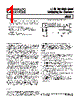


1. General Description:
️· What it is: The AD668 is a 12-bit, digitally programmed precision analog multiplier/DAC. Think of it as a versatile component that can perform both analog multiplication and generate precise analog voltages or currents based on digital inputs.
️· Flexibility: It can operate in several configurations:
- As a precision analog multiplier (using two analog inputs).
- As a digitally programmed voltage output DAC.
- As a digitally programmed current output DAC.
️· Programming: It's digitally programmable, meaning a microcontroller or other digital system can control its output.
️· Laser Trimmed: The linearity of the DAC is improved through laser trimming.
2. Features (Key Capabilities):
️· 12-bit Resolution: Provides a fine degree of precision in the analog output.
️· Programmability: Multiple operating modes (multiplier, voltage DAC, current DAC) controlled digitally.
️· Digital Inputs: Accepts digital data and control signals.
️· Error Correction: Laser trimming minimizes linearity errors.
️· Multiple Operating Modes: Allows for diverse applications.
3. Electrical Specifications & Performance:
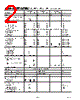
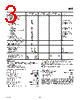
️· Linearity Error: Critical for accuracy. The datasheet specifies maximum linearity error based on the grade (J, K, S) – crucial to understand the accuracy.
- K-grade: ±1/4 LSB (0.006% of FS)
- J & S grades: ±1/2 LSB
️· Gain Error: Indicates the deviation from the ideal output span.
️· Settling Time: How quickly the output stabilizes after a digital change. (Digital & Analog settling times are both specified.)
️· Voltage/Current Output: Can generate precise analog voltages or currents.
️· Temperature Range: Different versions operate across different temperature ranges (0°C to +70°C, -40°C to +85°C, -55°C to +125°C).
️· Power Supply: Operates on +/-18V supplies (with some specific voltage limits).
4. Important Definitions (Key Concepts):
️· LSB (Least Significant Bit): The smallest increment the DAC can represent. Linearity errors and gain errors are typically expressed relative to the LSB.
️· DAC Offset: Error caused by a non-zero output when the digital input should be zero.
️· Monotonicity: The DAC's output must consistently increase or decrease with increasing digital input.
️· Compliance Voltage: The voltage allowed at the output node to maintain accuracy.
5. Absolute Maximum Ratings:
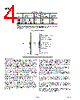
️· Defines the limits of voltage, current, and temperature beyond which the device could be damaged. (Very important to avoid!)
6. Ordering Information:
️· Lists the available models (grade, temperature range, package type).
️· Model Examples:
- `AD668JQ`: 0°C to +70°C temperature range, Q-24 package (Cerdip)
- `AD668SQ`: -55°C to +125°C temperature range, Q-24 package (Cerdip)
7. Package Options:
️· Q-24: Refers to the package type (Cerdip).
Key Takeaways:
️· Versatile: The AD668 is a multi-mode device, offering precision analog multiplication and DAC functionality.
️· Accuracy is Critical: Pay close attention to the linearity error specifications, as they directly impact the accuracy of the analog output. The higher grades (like 'K') offer better linearity.
️· Temperature Range: Select a model that is appropriate for the application's operating temperature.
️· Power Supply Considerations: Be mindful of the power supply requirements.
️· Careful Operation: Avoid exceeding the absolute maximum ratings to prevent damage.
️· Understanding Definitions: The glossary of terms is essential for fully interpreting the specifications.
1. General Description:
️· What it is: The AD668 is a 12-bit, digitally programmed precision analog multiplier/DAC. Think of it as a versatile component that can perform both analog multiplication and generate precise analog voltages or currents based on digital inputs.
️· Flexibility: It can operate in several configurations:
- As a precision analog multiplier (using two analog inputs).
- As a digitally programmed voltage output DAC.
- As a digitally programmed current output DAC.
️· Programming: It's digitally programmable, meaning a microcontroller or other digital system can control its output.
️· Laser Trimmed: The linearity of the DAC is improved through laser trimming.
2. Features (Key Capabilities):
️· 12-bit Resolution: Provides a fine degree of precision in the analog output.
️· Programmability: Multiple operating modes (multiplier, voltage DAC, current DAC) controlled digitally.
️· Digital Inputs: Accepts digital data and control signals.
️· Error Correction: Laser trimming minimizes linearity errors.
️· Multiple Operating Modes: Allows for diverse applications.
3. Electrical Specifications & Performance:
️· Linearity Error: Critical for accuracy. The datasheet specifies maximum linearity error based on the grade (J, K, S) – crucial to understand the accuracy.
- K-grade: ±1/4 LSB (0.006% of FS)
- J & S grades: ±1/2 LSB
️· Gain Error: Indicates the deviation from the ideal output span.
️· Settling Time: How quickly the output stabilizes after a digital change. (Digital & Analog settling times are both specified.)
️· Voltage/Current Output: Can generate precise analog voltages or currents.
️· Temperature Range: Different versions operate across different temperature ranges (0°C to +70°C, -40°C to +85°C, -55°C to +125°C).
️· Power Supply: Operates on +/-18V supplies (with some specific voltage limits).
4. Important Definitions (Key Concepts):
️· LSB (Least Significant Bit): The smallest increment the DAC can represent. Linearity errors and gain errors are typically expressed relative to the LSB.
️· DAC Offset: Error caused by a non-zero output when the digital input should be zero.
️· Monotonicity: The DAC's output must consistently increase or decrease with increasing digital input.
️· Compliance Voltage: The voltage allowed at the output node to maintain accuracy.
5. Absolute Maximum Ratings:
️· Defines the limits of voltage, current, and temperature beyond which the device could be damaged. (Very important to avoid!)
6. Ordering Information:
️· Lists the available models (grade, temperature range, package type).
️· Model Examples:
- `AD668JQ`: 0°C to +70°C temperature range, Q-24 package (Cerdip)
- `AD668SQ`: -55°C to +125°C temperature range, Q-24 package (Cerdip)
7. Package Options:
️· Q-24: Refers to the package type (Cerdip).
Key Takeaways:
️· Versatile: The AD668 is a multi-mode device, offering precision analog multiplication and DAC functionality.
️· Accuracy is Critical: Pay close attention to the linearity error specifications, as they directly impact the accuracy of the analog output. The higher grades (like 'K') offer better linearity.
️· Temperature Range: Select a model that is appropriate for the application's operating temperature.
️· Power Supply Considerations: Be mindful of the power supply requirements.
️· Careful Operation: Avoid exceeding the absolute maximum ratings to prevent damage.
️· Understanding Definitions: The glossary of terms is essential for fully interpreting the specifications.
| Part No. | AD668 |
| Manufacturer | AD |
| Size | 221 Kbytes |
| Pages | 16 pages |
| Description | 12-Bit Ultrahigh Speed Multiplying D/A Converter |
| War ALLDATASHEET hilfreich? [ DONATE ] |
Über Alldatasheet | Werbung | Kontakt | Privatsphäre und Datenschutz | Link zum Datenblatt | Linktausch | Hersteller All Rights Reserved©Alldatasheet.com |
| Russian : Alldatasheetru.com | Korean : Alldatasheet.co.kr | Spanish : Alldatasheet.es | French : Alldatasheet.fr | Italian : Alldatasheetit.com Portuguese : Alldatasheetpt.com | Polish : Alldatasheet.pl | Vietnamese : Alldatasheet.vn Indian : Alldatasheet.in | Mexican : Alldatasheet.com.mx | British : Alldatasheet.co.uk | New Zealand : Alldatasheet.co.nz |
|
Family Site : ic2ic.com |
icmetro.com |
 German ▼
  English
 Chinese
 Japanese
 Russian
 Korean
 Spanish
 French
 Italian
 Portuguese
 Polish
 Vietnamese
 Indian
 Mexican
 British
 New Zealand