 |
Datenblatt-Suchmaschine für elektronische Bauteile |
|
|
Datenblatt-Suchmaschine für elektronische Bauteile |
|
The question interval is too short.
Please try again in a few seconds.

Hello, Please ask a question about PA94 Datasheet
# Example questions:
➢ What is the recommended minimum value for the current limit resistor (r lim) and what is the maximum practical value?
➢ What are the two critical factors regarding the compensation capacitor (cc) and why are they important?
➢ The document details restrictions on the common mode input voltage range. explain these restrictions and provide an example of a scenario where these restrictions would be relevant.
| Part No. | PA94 |
| Manufacturer | APEX |
| Size | 224 Kbytes |
| Pages | 4 pages |
| Description | HIGH VOLTAGE POWER OPERATIONAL AMPLIFIERS |


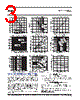
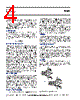

Okay, I'm ready to summarize the provided text about the Apex PA94 amplifier. Here's a breakdown, categorized for clarity:
1. General Overview & Key Features
️· High Voltage & Speed: The PA94 is a high-voltage, high-speed amplifier.
️· Unique Design: Requires special considerations for heatsink selection due to its combined high voltage and speed.
️· Reference Materials: Users should review Application Note 1 ("General Operating Considerations") and visit Apex's website ([www.apexmicrotech.com](http://www.apexmicrotech.com)) for design tools, application notes, technical seminars, and evaluation kits.
2. Operating Considerations
️· Current Limit: A current limit resistor (R LIM) is required, with a minimum value of 3.5 ohms and a recommended maximum of 30 ohms.
️· Common Mode Input Range: The input pins must be at least 30V from either supply voltage, but never more than 450V from either supply. The output has fewer restrictions.
️· Input Protection: External protection (diodes or JFETs) is recommended to limit differential input voltages to ±.7V.
️· Power Supply Protection: Unidirectional zener diodes are recommended on supply pins to clamp transients and prevent polarity reversals.
️· Stability: Requires a 2.2 pF NPO compensation capacitor (rated for the total supply voltage) mounted close to pins 4 and 6 for stability.
️· External Components: Use high-voltage rated resistors for the feedback network, or use multiple lower-rated resistors in series.
3. Heat Sink Selection
️· Traditional Formulas Inadequate: Standard heat sink calculations don't accurately account for the PA94's characteristics.
️· Power Design Tool: Use Apex's "Power Design" spreadsheet (available on the website) or the provided formulas to determine appropriate heat sink ratings for both case temperature and junction temperature.
- Calculations involve internal dissipation (PD), quiescent power (PDQ), and output stage quiescent power (PDQOUT)
- Heat sink selection must maintain case temperature below 85°C and junction temperature below 150°C.
4. Safety and Cautions
️· Lethal Voltages: Operating voltages are potentially lethal.
️· Low Voltage Testing: Develop circuits at low voltages initially.
️· Clip Test Leads: Use clip test leads for measurements during troubleshooting.
In essence, the text is a detailed guide to safely and effectively using the Apex PA94 amplifier, emphasizing the need for careful design and consideration of potential hazards.
Do you want me to elaborate on any of these points or summarize a specific aspect of the documentation?
1. General Overview & Key Features
️· High Voltage & Speed: The PA94 is a high-voltage, high-speed amplifier.
️· Unique Design: Requires special considerations for heatsink selection due to its combined high voltage and speed.
️· Reference Materials: Users should review Application Note 1 ("General Operating Considerations") and visit Apex's website ([www.apexmicrotech.com](http://www.apexmicrotech.com)) for design tools, application notes, technical seminars, and evaluation kits.
2. Operating Considerations
️· Current Limit: A current limit resistor (R LIM) is required, with a minimum value of 3.5 ohms and a recommended maximum of 30 ohms.
️· Common Mode Input Range: The input pins must be at least 30V from either supply voltage, but never more than 450V from either supply. The output has fewer restrictions.
️· Input Protection: External protection (diodes or JFETs) is recommended to limit differential input voltages to ±.7V.
️· Power Supply Protection: Unidirectional zener diodes are recommended on supply pins to clamp transients and prevent polarity reversals.
️· Stability: Requires a 2.2 pF NPO compensation capacitor (rated for the total supply voltage) mounted close to pins 4 and 6 for stability.
️· External Components: Use high-voltage rated resistors for the feedback network, or use multiple lower-rated resistors in series.
3. Heat Sink Selection
️· Traditional Formulas Inadequate: Standard heat sink calculations don't accurately account for the PA94's characteristics.
️· Power Design Tool: Use Apex's "Power Design" spreadsheet (available on the website) or the provided formulas to determine appropriate heat sink ratings for both case temperature and junction temperature.
- Calculations involve internal dissipation (PD), quiescent power (PDQ), and output stage quiescent power (PDQOUT)
- Heat sink selection must maintain case temperature below 85°C and junction temperature below 150°C.
4. Safety and Cautions
️· Lethal Voltages: Operating voltages are potentially lethal.
️· Low Voltage Testing: Develop circuits at low voltages initially.
️· Clip Test Leads: Use clip test leads for measurements during troubleshooting.
In essence, the text is a detailed guide to safely and effectively using the Apex PA94 amplifier, emphasizing the need for careful design and consideration of potential hazards.
| Part No. | PA94 |
| Manufacturer | APEX |
| Size | 224 Kbytes |
| Pages | 4 pages |
| Description | HIGH VOLTAGE POWER OPERATIONAL AMPLIFIERS |
| War ALLDATASHEET hilfreich? [ DONATE ] |
Über Alldatasheet | Werbung | Kontakt | Privatsphäre und Datenschutz | Link zum Datenblatt | Linktausch | Hersteller All Rights Reserved©Alldatasheet.com |
| Russian : Alldatasheetru.com | Korean : Alldatasheet.co.kr | Spanish : Alldatasheet.es | French : Alldatasheet.fr | Italian : Alldatasheetit.com Portuguese : Alldatasheetpt.com | Polish : Alldatasheet.pl | Vietnamese : Alldatasheet.vn Indian : Alldatasheet.in | Mexican : Alldatasheet.com.mx | British : Alldatasheet.co.uk | New Zealand : Alldatasheet.co.nz |
|
Family Site : ic2ic.com |
icmetro.com |
 German ▼
  English
 Chinese
 Japanese
 Russian
 Korean
 Spanish
 French
 Italian
 Portuguese
 Polish
 Vietnamese
 Indian
 Mexican
 British
 New Zealand