 |
Datenblatt-Suchmaschine für elektronische Bauteile |
|
|
Datenblatt-Suchmaschine für elektronische Bauteile |
|
The question interval is too short.
Please try again in a few seconds.

Hello, Please ask a question about AAT4250 Datasheet
# Example questions:
➢ What is the primary factor limiting the maximum safe operating output current of the aat4250?
➢ What are two recommended pcb layout practices for optimal performance of the aat4250?
➢ The document details a method for calculating total power dissipation with pulsed loads. explain the two steps involved and what each step calculates.
| Part No. | AAT4250 |
| Manufacturer | AAT |
| Size | 189 Kbytes |
| Pages | 13 pages |
| Description | Slew Rate Controlled Load Switch |


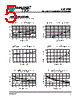
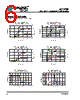
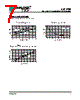
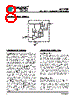



Okay, I've carefully reviewed the provided text. Here's a breakdown of the key information from the AAT4250 Slew Rate Controlled Load Switch datasheet extract, organized for clarity:
1. Overview & Purpose:
️· The AAT4250 is a slew-rate controlled load switch designed for efficient power management in various applications. The "slew rate controlled" aspect means it limits the speed at which the current ramps up or down, preventing unwanted voltage spikes.
2. Key Features & Benefits:
️· Slew Rate Control: Minimizes voltage spikes and improves system stability.
️· Low Rds(on): Reduces power losses.
️· Thermal Management: Designed to handle continuous output current.
3. Electrical Characteristics & Performance:
️· Maximum Continuous Output Current: This depends heavily on thermal considerations (ambient temperature, heatsinking, etc.).
️· Rds(on) (Drain-Source Resistance): This is a critical factor in power dissipation. The text provides information on how to approximate Rds(on) at different voltages.
️· Pulsed Current (I DM): A higher peak current can be handled briefly, but the datasheet specifies limits and how to calculate safe duty cycles.
️· Thermal Limits: T<sub>J(MAX)</sub> (maximum junction temperature) is 125°C, and θ<sub>JA</sub> (thermal resistance) is 150°C/W.
4. Thermal Considerations & Calculations:
️· Maximum Power Dissipation (P<sub>D(MAX)</sub>): Calculated based on junction temperature, ambient temperature, and thermal resistance. The datasheet provides equations to calculate this.
️· Duty Cycle Calculation: The text illustrates how to calculate the allowable duty cycle for high peak currents, considering the thermal limits.
️· Printed Circuit Board Layout Recommendations: Essential for proper thermal performance and minimizing Rds(on). Include wider traces for power lines and a ground plane.
️· Thermal Management:
- Heatsinking: Reduce thermal resistance to improve performance.
- Duty Cycling: Limit the on-time to reduce power dissipation.
5. High Peak Output Current Applications:
️· The text provides a detailed example of how to calculate the maximum duty cycle for high-peak current applications (e.g., GSM) to ensure safe operation.
6. Evaluation Board:
️· The datasheet refers to an evaluation board with accompanying diagrams (top, bottom, assembly) for reference.
In simpler terms: The AAT4250 is a smart power switch that’s designed to be efficient and stable. To get the best performance and avoid overheating, pay close attention to how you design the circuit board and how much current you’re drawing.
1. Overview & Purpose:
️· The AAT4250 is a slew-rate controlled load switch designed for efficient power management in various applications. The "slew rate controlled" aspect means it limits the speed at which the current ramps up or down, preventing unwanted voltage spikes.
2. Key Features & Benefits:
️· Slew Rate Control: Minimizes voltage spikes and improves system stability.
️· Low Rds(on): Reduces power losses.
️· Thermal Management: Designed to handle continuous output current.
3. Electrical Characteristics & Performance:
️· Maximum Continuous Output Current: This depends heavily on thermal considerations (ambient temperature, heatsinking, etc.).
️· Rds(on) (Drain-Source Resistance): This is a critical factor in power dissipation. The text provides information on how to approximate Rds(on) at different voltages.
️· Pulsed Current (I DM): A higher peak current can be handled briefly, but the datasheet specifies limits and how to calculate safe duty cycles.
️· Thermal Limits: T<sub>J(MAX)</sub> (maximum junction temperature) is 125°C, and θ<sub>JA</sub> (thermal resistance) is 150°C/W.
4. Thermal Considerations & Calculations:
️· Maximum Power Dissipation (P<sub>D(MAX)</sub>): Calculated based on junction temperature, ambient temperature, and thermal resistance. The datasheet provides equations to calculate this.
️· Duty Cycle Calculation: The text illustrates how to calculate the allowable duty cycle for high peak currents, considering the thermal limits.
️· Printed Circuit Board Layout Recommendations: Essential for proper thermal performance and minimizing Rds(on). Include wider traces for power lines and a ground plane.
️· Thermal Management:
- Heatsinking: Reduce thermal resistance to improve performance.
- Duty Cycling: Limit the on-time to reduce power dissipation.
5. High Peak Output Current Applications:
️· The text provides a detailed example of how to calculate the maximum duty cycle for high-peak current applications (e.g., GSM) to ensure safe operation.
6. Evaluation Board:
️· The datasheet refers to an evaluation board with accompanying diagrams (top, bottom, assembly) for reference.
| Part No. | AAT4250 |
| Manufacturer | AAT |
| Size | 189 Kbytes |
| Pages | 13 pages |
| Description | Slew Rate Controlled Load Switch |
| War ALLDATASHEET hilfreich? [ DONATE ] |
Über Alldatasheet | Werbung | Kontakt | Privatsphäre und Datenschutz | Link zum Datenblatt | Linktausch | Hersteller All Rights Reserved©Alldatasheet.com |
| Russian : Alldatasheetru.com | Korean : Alldatasheet.co.kr | Spanish : Alldatasheet.es | French : Alldatasheet.fr | Italian : Alldatasheetit.com Portuguese : Alldatasheetpt.com | Polish : Alldatasheet.pl | Vietnamese : Alldatasheet.vn Indian : Alldatasheet.in | Mexican : Alldatasheet.com.mx | British : Alldatasheet.co.uk | New Zealand : Alldatasheet.co.nz |
|
Family Site : ic2ic.com |
icmetro.com |
 German ▼
  English
 Chinese
 Japanese
 Russian
 Korean
 Spanish
 French
 Italian
 Portuguese
 Polish
 Vietnamese
 Indian
 Mexican
 British
 New Zealand